Looking for the best treks in Morocco? From the summit of Toubkal to the volcanic towers of Saghro, Morocco offers great hiking all year round. Below, our local guides compare the five treks we love most, so you can choose the right one for your dates and fitness.
In short: Toubkal for the summit, Saghro for winter, M’Goun for wild landscapes, and Imlil for an easy day in the mountains.
Best treks in Morocco: quick comparison
| Trek | Days | Difficulty | Season |
|---|---|---|---|
| Atlas Mountains day hike (Imlil) | 1 day | Easy | All year |
| Toubkal trek | 2 days | Demanding | Apr–Oct |
| Toubkal via Azzaden | 3 days | Moderate–demanding | Apr–Oct |
| Jbel Saghro | 5 days | Moderate | Oct–Apr |
| M’Goun | 5 days | Demanding | May–Oct |
1. Mount Toubkal (2 or 3 days)
The classic. At 4,167 m, Toubkal is the highest peak in North Africa, and the climb from Imlil is non-technical in summer. Choose the Toubkal trek 2 days if you are fit and short on time, or the Toubkal trek 3 days for a quieter route and better acclimatisation. Read also how to climb Mount Toubkal.
2. Jbel Saghro (5 days)
The best winter trek in Morocco. Saghro is a volcanic range near the Sahara, with rock towers like Bab n’Ali, oasis villages and nomadic shepherds. See the Jbel Saghro trek.
3. M’Goun (5 days)
Wilder and quieter than Toubkal, the Mgoun trek climbs Morocco’s second highest peak (4,071 m) from the green Ait Bouguemez valley, with camps on high plateaus.
4. Atlas Mountains day hike (1 day)
No time for a multi-day trek? The Atlas Mountains day hike from Marrakech walks through Berber villages around Imlil, with lunch with a local family.
Toubkal in more detail
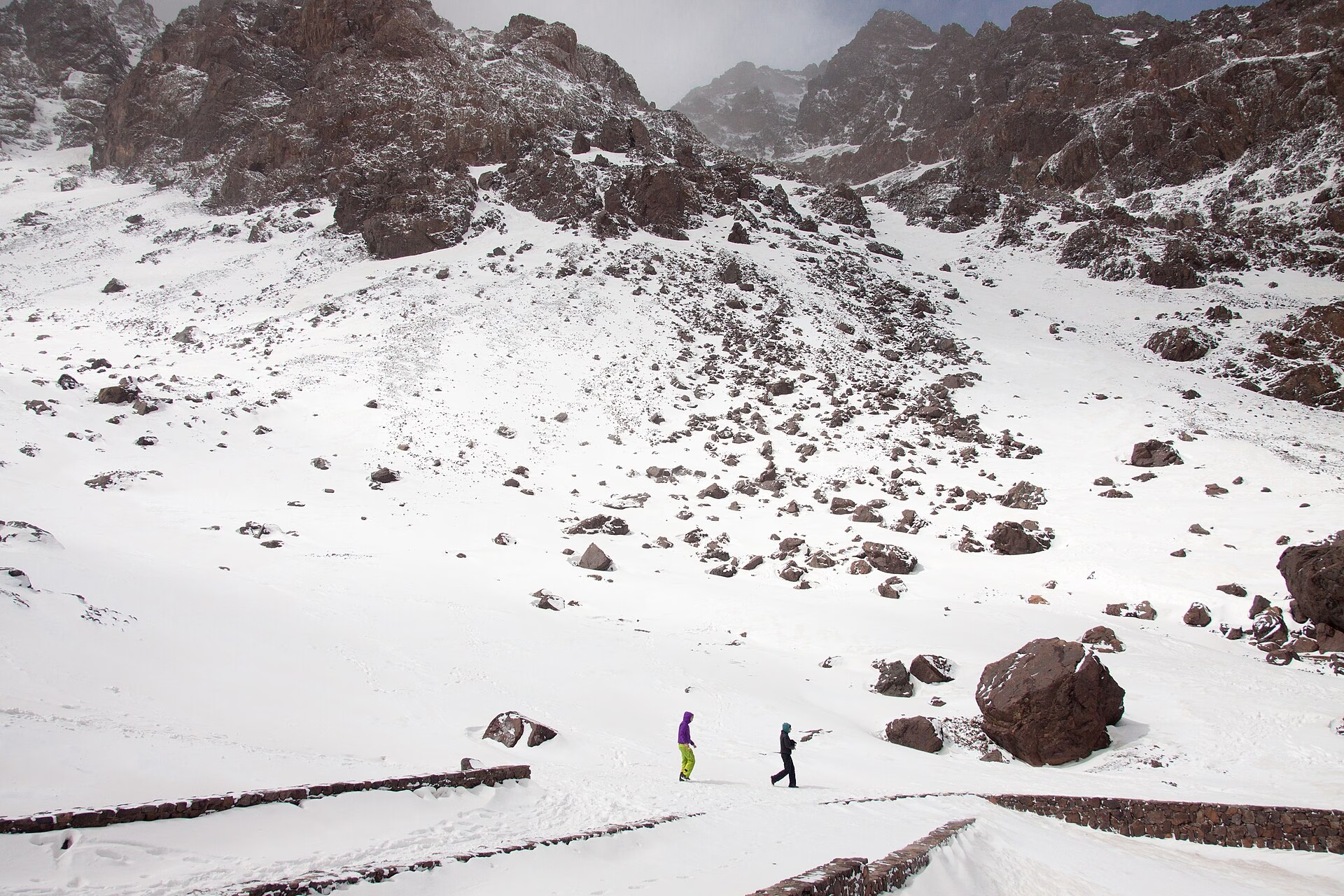
At 4,167 metres, Jbel Toubkal is the highest summit in North Africa. Most treks start in Imlil, about 90 minutes from Marrakech, and follow a mule path through Berber villages and walnut groves to the refuges at about 3,200 metres. On the summit day, you leave before dawn to reach the top at sunrise, with views over the whole High Atlas. The climb is not technical in summer and autumn, but it is long and steep, and altitude can be felt. In winter, snow and ice make it a mountaineering ascent that requires crampons, an ice axe and an experienced guide. See the Toubkal trek in 2 days or the 3-day version for a more gradual climb.
Jbel Saghro in more detail
Jbel Saghro is a volcanic massif between the High Atlas and the Sahara, with dramatic rock towers, canyons and plateaus. It is the land of the Ait Atta nomads, who still move their flocks between summer and winter pastures. Because it is low and dry, Saghro is the best trek in winter, from November to March, when the High Atlas is under snow. The nights are cold, but the days are sunny and pleasant for walking.
M’Goun in more detail
The M’Goun massif, with its summit at about 4,070 metres, is wilder and less visited than Toubkal. Treks often start in the green Ait Bouguemez valley and cross high passes, gorges and remote villages. In some sections, you walk in the river itself, between tall red cliffs. It is a demanding but unforgettable trek for walkers who want to see the most authentic side of the Atlas. Read more about the Ait Bouguemez valley.
How difficult are the treks?
Day hikes in the Atlas are easy to moderate and suit most travellers with normal fitness. Toubkal is moderate to hard because of the altitude and the long summit day. Saghro is moderate, with several days of walking on rocky paths. M’Goun is the most demanding, with long days, high passes and river crossings. In all cases, our local guides adapt the pace to the group, and mules carry the luggage on multi-day treks.
What is included on a guided trek
On our treks, a certified local mountain guide leads the group, mules and muleteers carry the bags, and a cook prepares the meals. You sleep in mountain refuges, village guesthouses or tents, depending on the route. Meals are hearty: tajines, couscous, soups, salads, fresh bread and mint tea. You only need to carry a small daypack with water, snacks and a warm layer.
What to pack for trekking in Morocco
- Good walking boots, already worn in.
- Layers: a breathable shirt, a fleece and a waterproof jacket.
- A warm hat and gloves for the summits and cold nights.
- Sunglasses, sunscreen and a sun hat.
- A sleeping bag for refuges or camps (we can arrange one).
- A reusable water bottle and water purification tablets.
- A head torch for early starts.
Respecting the mountains and their people
The Atlas is home to Amazigh families who have lived in these valleys for centuries. Dress modestly in villages, ask before taking photos and accept invitations for tea with a smile. Take all your rubbish back down, use toilets in villages and refuges, and support local guides, muleteers and guesthouses. This way, tourism helps the mountain communities and protects their landscapes.
Altitude and acclimatisation
Toubkal and M’Goun reach over 4,000 metres, where the air is thinner. Most walkers feel only a light headache or shortness of breath, but it is important to walk slowly, drink plenty of water and sleep well before the summit day. A three-day Toubkal trek, with an extra night in the valley, gives your body more time to adapt and makes the climb more enjoyable. If you feel unwell, tell your guide immediately; going down a few hundred metres is usually enough to feel better.
Day hikes from Marrakech
If you have only one day, the Atlas foothills offer beautiful walks less than two hours from the city. From Imlil, easy trails lead through walnut groves and Berber villages with views of Toubkal. In the Ourika valley, a short climb follows the waterfalls of Setti Fatma. These walks suit families and travellers who want a taste of the mountains without a multi-day trek. See our Atlas Mountains day hike.
Combining a trek with the desert
Many of our travellers combine two or three days of trekking with a desert tour. For example, you can climb Toubkal from Imlil, return to Marrakech, and then cross the Atlas to Ait Ben Haddou, the gorges and the dunes of Merzouga. In winter, a Saghro trek fits perfectly on the way to the Sahara, because the massif lies between the Dades valley and the desert.
Trekking with children
Families can enjoy the Atlas too. Short walks around Imlil, the Ourika valley or Ait Bouguemez are perfect for children, with mules to ride, streams to cross and villages to visit. For older children with good fitness, a two-day trek to the Toubkal refuge, without the summit, is a great first mountain adventure. Our guides adapt the distances and choose safe paths for the youngest walkers.
Safety in the mountains
The High Atlas is safe for trekkers, and walking with a licensed local guide is the best way to enjoy it. Since 2019, a guide is required for the Toubkal ascent. Weather can change quickly, especially in spring and autumn, so always carry a waterproof jacket and warm layers. Our guides check the forecast every day and change the route if needed.
Our team’s view
As a Berber family, we feel at home in the mountains, and trekking is one of the best ways to understand Morocco. Our advice: choose the route that matches your fitness and the season, take time to acclimatise, and let the rhythm of the villages slow you down.
When to trek in Morocco
In summer, head to the High Atlas: Toubkal and M’Goun. In winter, the high peaks are snowy, so choose Saghro or a lower day hike. Spring and autumn are good for almost every route.
Best treks in Morocco: FAQ
Do I need a guide to climb Toubkal?
Yes. Since 2019, a licensed guide is required for the ascent of Toubkal.
Which trek is best in winter?
Jbel Saghro, because it is lower and drier, with sunny days from November to March.
How much luggage can the mules carry?
Plenty. Mules carry your main bag, food and camping gear, so you only walk with a light daypack, water and a warm layer.
Can beginners trek in Morocco?
Yes. Day hikes in the Atlas and the two-day Toubkal trek are suitable for most fit beginners, with a local guide and mules for the bags.
What is the best trek in Morocco for beginners?
The Atlas Mountains day hike, or the Toubkal trek 3 days if you are fit.
What is the best trek in Morocco in winter?
Jbel Saghro, from October to April.
Do I need a guide?
On Toubkal, a licensed guide is required by local authorities, and on every route a local guide makes the trek safer and easier.
Can I combine trekking and the desert?
Yes. Many travellers add the 3 days Marrakech to Merzouga tour after their trek.
Do your guides speak Spanish?
Yes, our guides speak English and Spanish.
Trek Morocco with local guides
All our treks are private, with transfers from Marrakech, a licensed guide, mules and meals. See all our Morocco trekking tours.
Ready to plan your Morocco trip?
Tell us your dates and group size. We will send you a private route with your own driver, hand-picked riads and the price.
- Send us your dates and group size.
- We reply with a private day-by-day route and the price.
- You change anything you like; nothing is paid until you agree the plan.
★★★★★ 5.0 from 522 reviews on Tripadvisor
Main photo: Anass ERRIHANI, Wikimedia Commons, CC BY-SA 4.0.