
Wondering how to climb Mount Toubkal? At 4,167 metres, Jebel Toubkal is the highest peak in North Africa and the most popular trek in Morocco. From May to October it is a non-technical walk-up for fit hikers, with no ropes or climbing skills needed. In winter it becomes a real mountaineering climb on snow and ice. This guide explains the route step by step, the difficulty, how to train, what it costs, what to pack and the mistakes we see every season.
In short: drive 1.5 hours from Marrakech to Imlil, walk 5–6 hours to the Toubkal Refuge (3,207 m), sleep there, and leave before dawn to reach the summit in 3–4 hours. A licensed mountain guide is required. Choose 3 days if you want better acclimatisation.
Mount Toubkal at a glance
| Summit height | 4,167 m, the highest point in North Africa |
| Start point | Imlil (1,740 m), about 65 km and 1.5 hours from Marrakech |
| Where you sleep | Toubkal Refuge, 3,207 m (shared dormitories) |
| Total ascent | About 2,430 m from Imlil to the summit |
| Duration | 2 days (classic) or 3 days (quieter route, better acclimatisation) |
| Difficulty | Moderate to hard in summer; technical in winter (crampons and ice axe) |
| Best season | May to October without snow; April and November depend on conditions |
| Guide | A licensed mountain guide is required |
How to climb Mount Toubkal: the classic route, step by step
Marrakech to Imlil
The climb starts in Imlil, a Berber village at the end of the road in the Ait Mizane valley. The drive from Marrakech takes about 1.5 hours through Asni and the foothills of the High Atlas. In Imlil you meet your guide and the muleteer, and the mule takes your heavy bags up to the refuge.
Imlil to the Toubkal Refuge (5–6 hours)
From Imlil, the path passes the village of Aroumd and crosses a wide, stony riverbed. Then it climbs steadily along the valley to the small shrine of Sidi Chamharouch, at about 2,350 metres, where there are drink stalls and a lunch stop. After that, the path zigzags above the valley to the Toubkal Refuge at 3,207 metres. The walk is about 11–12 km. It is long rather than difficult, so keep a slow, regular pace and drink often.
Summit day: the refuge to the top (3–4 hours)
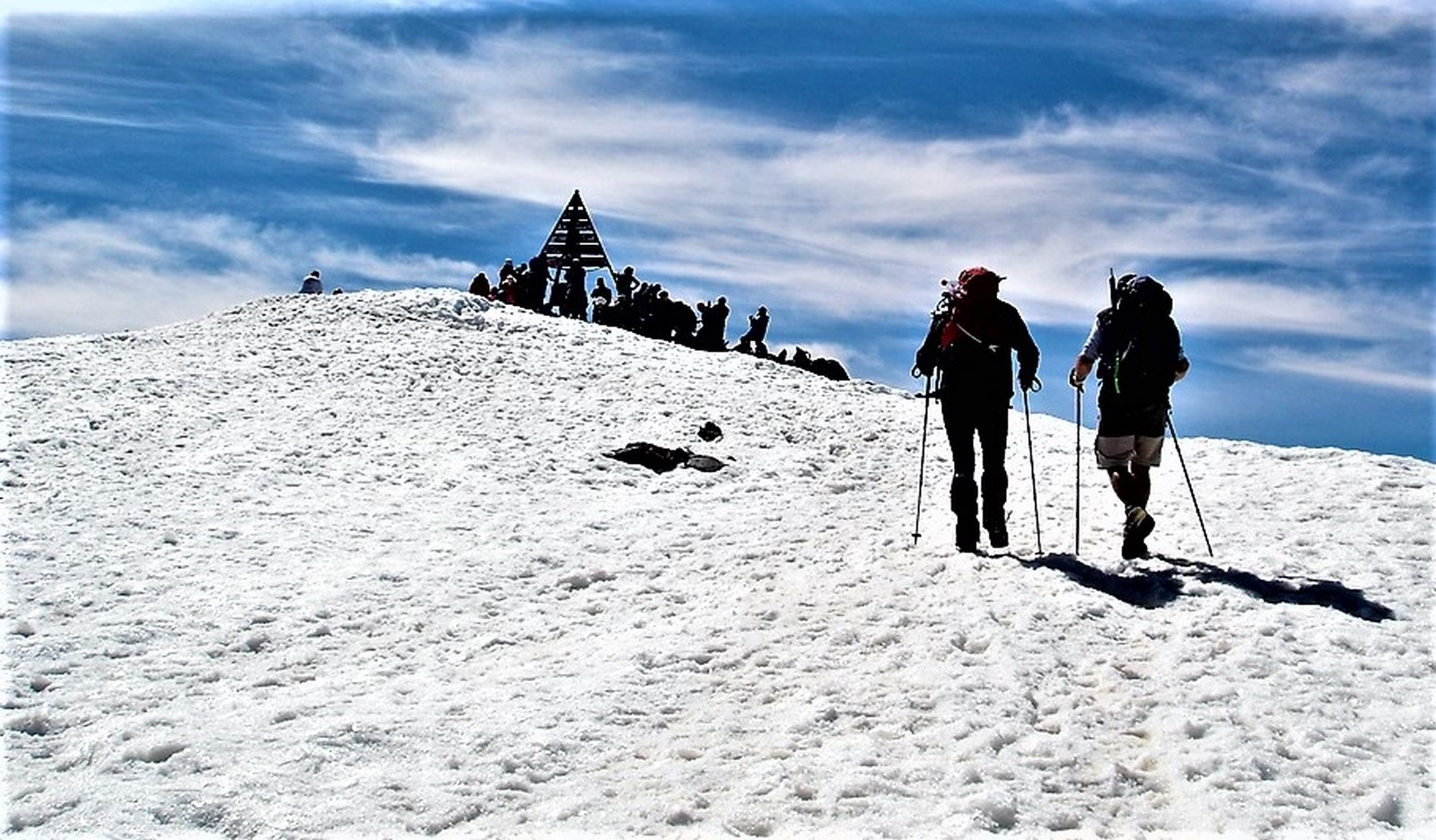
On summit day you leave around 4:00 or 5:00 AM with a head torch. The path climbs a steep slope of loose scree to a col, then follows a rocky ridge to the summit, marked by a metal tripod. This is the hardest part: about 960 metres of ascent in thin air. If the sky is clear, you see the whole High Atlas, and on very clear days the Sahara to the south.
The descent to Imlil
After the summit you go back down to the refuge for breakfast, and then all the way to Imlil. In total, summit day means about 960 m up and more than 2,400 m down, often 9 to 11 hours of walking. Many people find the descent harder than the climb, especially for the knees, so walking poles help a lot.
Toubkal in 2 days or 3 days?
| 2 days | 3 days | |
|---|---|---|
| Day 1 | Imlil to the refuge | Imlil via the Tizi n’Mzik pass to the Azzaden Valley |
| Day 2 | Summit and descent to Imlil | Azzaden Valley to the refuge, quieter path |
| Day 3 | – | Summit and descent to Imlil |
| Best for | Very fit hikers with little time | Most people: better acclimatisation, fewer crowds |
| Our trek | Toubkal trek 2 days | Toubkal trek 3 days |
If you have the time, we recommend 3 days. One extra night at altitude makes summit day much easier, and the Azzaden Valley, with its waterfalls and Berber villages, is one of the most beautiful parts of the Toubkal National Park.
How hard is it to climb Toubkal?
In summer, Toubkal needs no technical skills, but it is physically demanding. There are three challenges. First, the length: two long days of walking on rocky ground. Second, the altitude: above 3,000 metres many people feel a headache, tiredness or loss of appetite. Third, the descent, which is long and hard on the knees.
If you can walk 6 to 8 hours with ups and downs, and you have hiked in the mountains before, you can climb Toubkal. Children from about 12 years old who are used to hiking also reach the summit with a guide.
Altitude sickness
Mild symptoms such as a headache or poor sleep at the refuge are common and usually pass. To reduce the risk, walk slowly, drink 3 to 4 litres of water a day, eat well even if you are not hungry, and avoid alcohol. If symptoms get worse, such as vomiting, confusion or difficulty walking, the only treatment is to go down. Your guide will decide; always listen to them.
How to train for Mount Toubkal
Start 6 to 8 weeks before your trip. You do not need to be an athlete, but your legs must be used to long climbs and descents.
- Long hikes: one hike every weekend, building up to 6 hours with 800–1,000 m of ascent.
- Stairs or hills: two short sessions a week, also walking down to train your knees.
- Cardio: running, cycling or swimming two or three times a week.
- Test your boots: walk at least 30 km in them before the trek.
Best time to climb Toubkal
- May to June and September to October: the best months, with mild days and little or no snow.
- July and August: no snow and hot days in the valley, but cold mornings at the summit. The busiest time.
- November to April: snow and ice on the upper mountain. You need crampons, an ice axe and winter experience, and the summit can drop below −10 °C.
If you visit in winter and prefer warmer hiking, the Jbel Saghro trek in the volcanic desert mountains is a great alternative. For a longer summer trek away from the crowds, try the M’Goun trek in 5 days. Month by month weather is in our guide on the best time to visit Morocco.
Do I need a guide to climb Toubkal?
Yes. Since 2019, the Moroccan authorities require trekkers in the Toubkal area to go with a licensed mountain guide, and there can be checks at Imlil and on the path. Besides the rules, a local guide knows the route in fog or snow, books the refuge, organises the mule and makes the call on safety. Our guides are from the Atlas and speak English and Spanish.
Where you sleep: the Toubkal Refuge
There are two stone refuges side by side at 3,207 metres. Both have shared dormitories with mattresses and blankets, a dining room and basic washrooms. Hot meals are served at dinner and breakfast. In high season they can be full, so your guide books in advance. Bring a sleeping bag or a liner: nights are cold even in August.
What to pack for Toubkal
- Broken-in hiking boots with good grip.
- Walking poles, very useful on the descent.
- Layers: a base layer, a fleece and a warm down jacket for the summit.
- A windproof and waterproof jacket.
- A warm hat, gloves and a buff.
- A head torch with spare batteries for the night start.
- Sunglasses, sunscreen and lip balm: the sun is strong at altitude.
- A 1.5–2 litre water bottle or bladder, and snacks.
- A sleeping bag or liner for the refuge.
- Cash in dirhams for drinks, tips and extras in Imlil.
In winter, add crampons and an ice axe; your guide can arrange rental in Imlil.
How much does it cost to climb Toubkal?
The price of a guided Toubkal trek depends on the number of hikers, the number of days, the type of transfer from Marrakech and the season. A private trek usually includes the transfers, the licensed guide, the mule and muleteer, the refuge nights and meals on the mountain. Tips, drinks and personal gear are extra. Send us your dates and group size for a clear quote.
Mistakes to avoid on Toubkal
- Trying to climb it in one day from Marrakech. It is possible for a few very fit hikers, but you get no acclimatisation and it is the main reason people turn back.
- Arriving with new boots. Blisters on day 1 can end the trek.
- Underestimating the cold. At 5:00 AM on the summit ridge it can be near 0 °C in summer, with strong wind.
- Going too fast on day 1. A slow pace to the refuge is the best way to avoid altitude headaches.
- Booking with an unlicensed “guide” in Imlil. Ask for the official guide card.
Local tip from our team: spend the night before the trek in a guesthouse in Imlil instead of Marrakech. You start fresher, you avoid the early drive, and you get one more night to adapt to the mountains.
How to climb Mount Toubkal: FAQ
How long does it take to climb Mount Toubkal?
Usually 2 days from Imlil, or 3 days on the quieter route through the Azzaden Valley with better acclimatisation.
Is Toubkal suitable for beginners?
Yes, for fit beginners in summer who are used to long walks. In winter, you need experience with crampons and an ice axe.
Do I need a permit to climb Toubkal?
You do not need a paid permit, but you must go with a licensed mountain guide.
Where do you sleep on Toubkal?
At the Toubkal Refuge, at 3,207 m, in shared dormitories with meals.
Can I climb Toubkal in one day?
It is not recommended: it means about 2,400 m up and down in one day, with no acclimatisation.
Is there snow on Toubkal?
Usually from November to April. From May to October the normal route is free of snow.
How cold is it at the summit?
In summer, close to 0 °C at dawn with wind. In winter, it can drop below −10 °C.
Want an easier taste of the mountains?
Try the Atlas Mountains day hike from Marrakech.
Climb Toubkal with a local team
Our private Toubkal treks include transfers from Marrakech, a licensed guide who speaks English and Spanish, a mule and muleteer, refuge nights and meals on the mountain. You can add the climb to a desert trip: many travellers combine it with our tours from Marrakech. See all our Morocco trekking tours.
Ready to climb Mount Toubkal?
Tell us your dates, group size and fitness level. We will suggest the best route and send you a clear price.
- Send us your dates and group size.
- We reply with a private day-by-day route and the price.
- You change anything you like; nothing is paid until you agree the plan.
★★★★★ 5.0 from 522 reviews on Tripadvisor
Main photo: Toubkal4167, Wikimedia Commons, CC BY-SA 4.0.